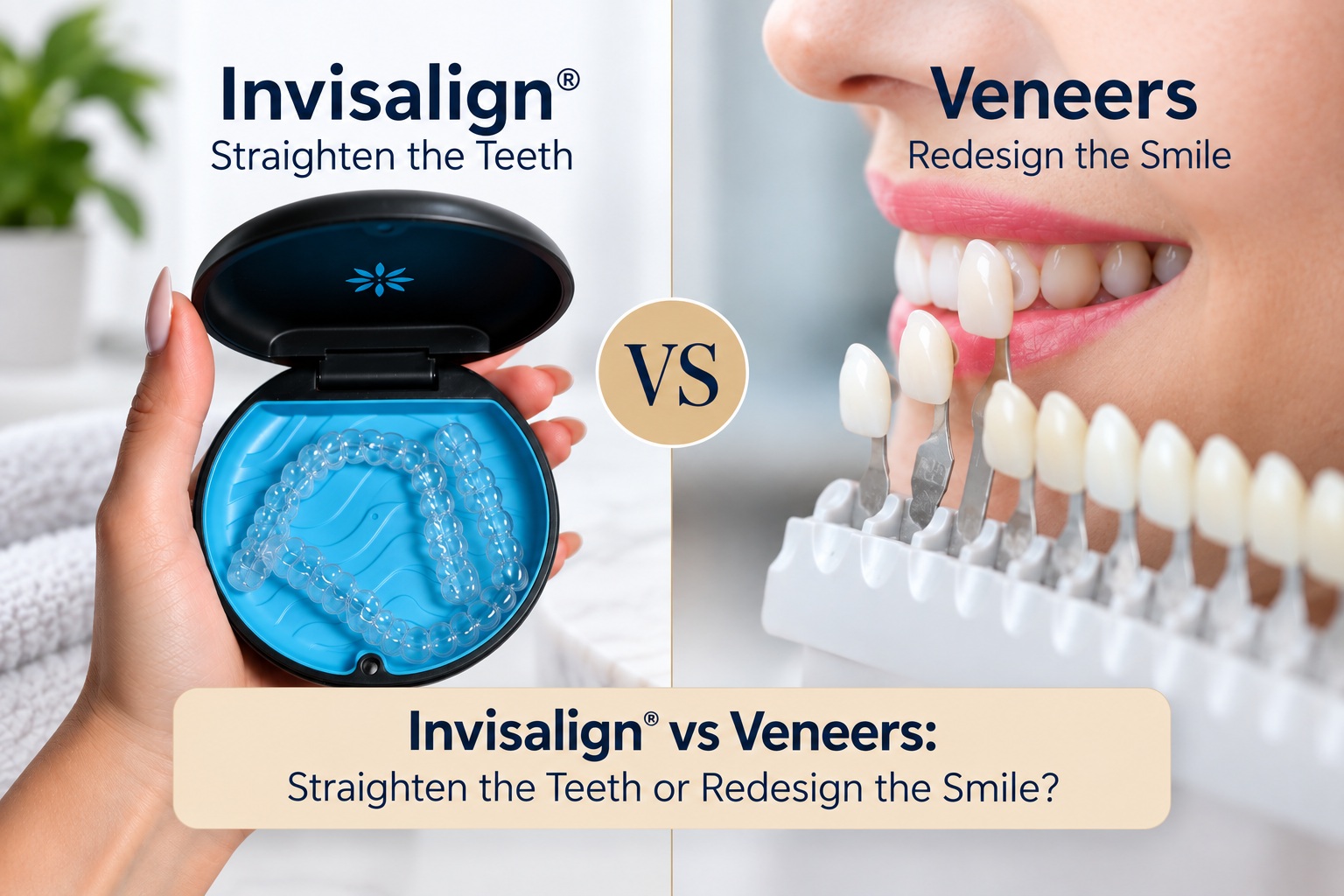
Invisalign vs veneers comes down to what you want to change. Invisalign® is an orthodontic treatment that gradually moves your natural teeth into new positions, while veneers are thin coverings placed over the front of teeth to change their visible shape, color, size, or overall appearance. In some cases, patients may benefit from one treatment; in others, Invisalign® followed by cosmetic treatment may be considered.
Both can create a noticeable smile transformation, but they accomplish that goal in very different ways. Understanding those differences can help you have a more productive conversation with your dentist about the right approach for your teeth.
Invisalign vs Veneers: What’s the Main Difference?
The easiest way to understand Invisalign vs veneers is this:
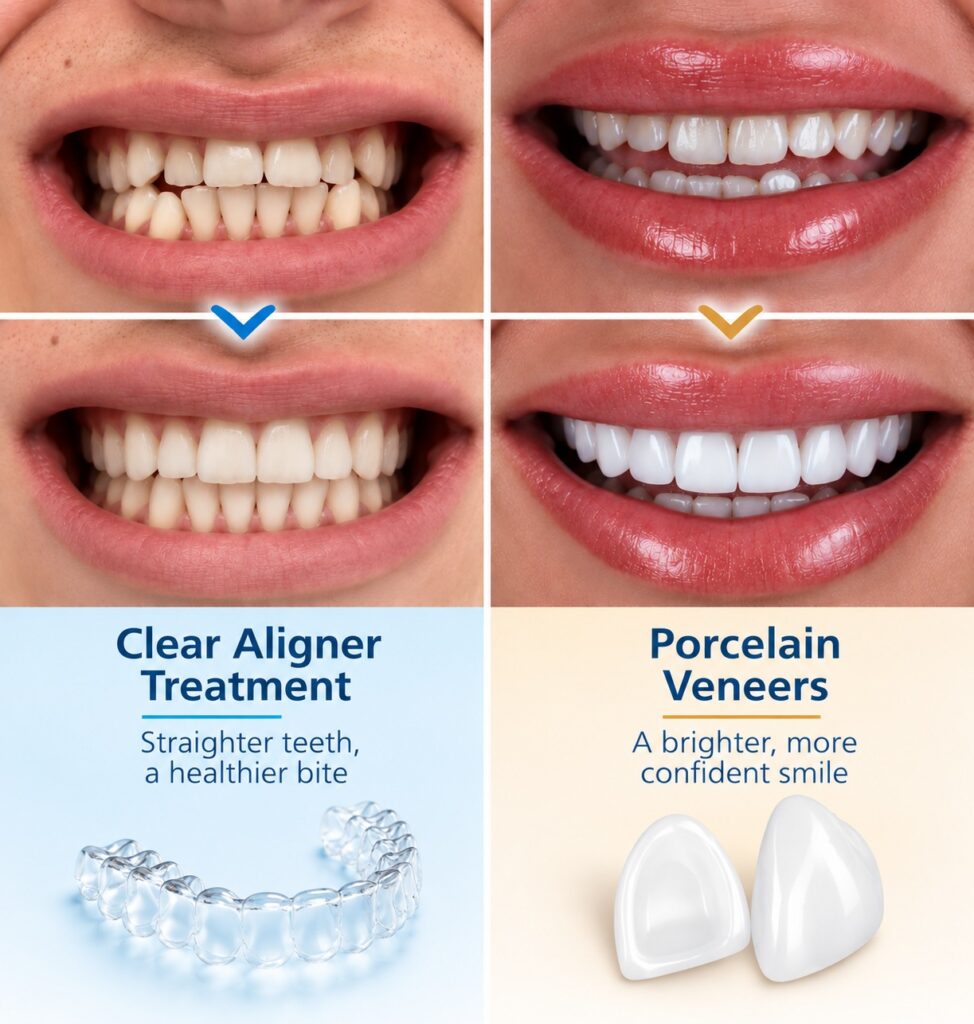
Invisalign® changes the position of your teeth. Dental veneers change how the visible surfaces of your teeth look.
Invisalign® uses a series of customized, removable clear aligners to gradually move teeth. Your provider creates a digital treatment plan that maps out the intended tooth movements and monitors your progress throughout treatment.
Dental veneers work differently. The American Dental Association describes veneers as custom-made coverings placed over the front surface of teeth. They may be used to improve the appearance of teeth that are chipped, stained, crooked, misshapen, or separated by visible gaps.
Here’s a quick comparison:
| Invisalign® | Veneers |
| Moves natural teeth | Covers the front surface of teeth |
| Orthodontic treatment | Primarily cosmetic treatment |
| Can address crowding and certain bite problems | Can change visible shape, size and color |
| Uses removable clear aligners | Veneers are bonded to teeth |
| Treatment occurs gradually | Cosmetic change occurs after veneers are placed |
| Retainers are generally needed afterward | Veneers may eventually need repair or replacement |
When Does Invisalign® Make More Sense?
If the main concern is where your teeth are positioned, Invisalign® may be considered to gradually move them according to an individualized treatment plan. It can address concerns such as:
- Crowded or overlapping teeth
- Gaps caused by tooth positioning
- Teeth that have shifted after previous orthodontic treatment
- Crooked teeth
- Certain overbites, underbites or crossbites
- Alignment issues that make your smile look uneven
For example, if your front teeth overlap but you like their natural color and shape, Invisalign® may address their actual position rather than simply making them appear straighter.
When Might Veneers Be Considered?
If you’re happy with the general position of your teeth but dislike their shape, proportions, or color, veneers may be worth discussing. According to Cleveland Clinic, dental veneers can camouflage several cosmetic concerns, including:
- Chipped or broken teeth
- Gaps or spaces between teeth
- Stains or discoloration
- Misshapen teeth
- Teeth that appear too small
For example, if one front tooth is noticeably smaller than the other, moving it may not correct the difference in shape. A veneer could potentially address the proportion more directly. Unlike orthodontic treatment, however, veneers change the visible surface of a tooth rather than repositioning it.
Invisalign vs Veneers for Crooked Teeth
If teeth are crowded, rotated, or poorly positioned, Invisalign® may address the underlying alignment. Clear aligners can treat many cases of crowded teeth, depending on an individual evaluation. Veneers may make certain mildly uneven teeth look straighter, but they don’t orthodontically reposition them.
If you’re comparing Invisalign or veneers for crooked teeth, ask:
- Is the problem primarily tooth position?
- Is it primarily tooth shape or color?
- Is my bite involved?
- How much healthy tooth structure would need to be altered?
- Could orthodontic treatment reduce the amount of cosmetic work I need?
The answers can point toward very different treatment plans.
Do Veneers Require Removing Tooth Enamel?
This is an important consideration when comparing Invisalign vs veneers.
Invisalign® moves your existing teeth without covering their front surfaces.
For porcelain veneers, however, the American Dental Association explains that a dentist removes a small amount of enamel from the front and sides of the tooth before the veneer is bonded. Because enamel is removed, the ADA describes veneer treatment as not reversible.
Composite veneers may require less enamel removal. The important distinction is that Invisalign® moves natural teeth, while veneers may require altering tooth structure to support a cosmetic restoration.
Can You Get Invisalign® Before Veneers?
Yes, there are situations where orthodontic and cosmetic treatment can complement each other.
Suppose your teeth are crowded and one or two teeth are chipped, worn, unusually shaped, or discolored.
Instead of using veneers alone to camouflage every issue, a dentist might consider correcting tooth position first and then evaluating what cosmetic treatment is still necessary.
A potential treatment sequence could look like:
- Evaluate your teeth, gums and bite
- Use Invisalign® to improve alignment when appropriate
- Complete orthodontic treatment and stabilize the result
- Reassess the smile
- Consider whitening, bonding, veneers, or other cosmetic treatment only where still needed
This type of combination approach can be useful because orthodontic treatment may change the position and spacing of the teeth before the final cosmetic design is planned.
The exact sequence depends on your oral health, bite, existing dental work, cosmetic goals, and the condition of your teeth.
Invisalign® vs Veneers: Which Changes More About Your Smile?
It depends on what you mean by “change.”
Invisalign® changes alignment. Your teeth gradually move toward the positions mapped out in your treatment plan. Invisalign® providers can use digital scanning and ClinCheck® software to plan and monitor those movements.
Veneers change appearance. They can alter visible characteristics such as tooth shape, size, proportion, and color.
Think about it this way:
If you like your teeth but not where they are → consider orthodontic options.
If you like where your teeth are but not how they look → discuss cosmetic options.
If you have concerns about both → ask whether a combination approach makes sense.
That framework isn’t a diagnosis, but it’s a useful starting point for your consultation.
What Should You Consider Before Choosing?
Before deciding between Invisalign vs veneers, look beyond which option seems faster or produces the most dramatic before-and-after photo.
Ask your dentist about:
Your Bite
If your concern involves how your upper and lower teeth fit together, cosmetic reshaping alone may not address it.
Your Natural Tooth Structure
Ask whether treatment requires altering healthy enamel and, if so, how much.
Your Cosmetic Goals
Do you primarily want straighter teeth, or are color, shape, size, chips, and proportions equally important?
Long-Term Maintenance
After Invisalign® treatment, retainers are needed to help maintain tooth position.
Veneers require good oral hygiene and ongoing dental care, and the ADA notes that a veneer can chip, crack, wear down, loosen, or eventually require repair or replacement.
Your Oral Health
Any existing dental problems need to be considered first. The ADA specifically advises that issues such as decay or gum disease should be treated before veneers are placed.
Why a Personalized Smile Evaluation Matters
Two patients can dislike their smiles for very different reasons. One may have healthy teeth that overlap, while another has straight teeth but dislikes their color, shape, or a visible chip.
A comprehensive evaluation of your teeth, gums, bite, existing dental work, and goals can help determine whether Invisalign®, cosmetic dentistry, or a coordinated approach should be considered.
Frequently Asked Questions About Invisalign vs Veneers
Is Invisalign® better than veneers for crooked teeth?
They solve different problems. Invisalign® actually moves teeth and may be appropriate when crookedness results from tooth position or crowding. Veneers cover the front surface and can change how teeth look without providing orthodontic tooth movement. The appropriate choice depends on your alignment, bite, tooth structure, and cosmetic goals.
Can veneers straighten your teeth?
Veneers can make certain mildly uneven or misshapen teeth appear straighter, but they don’t orthodontically move the teeth. If actual tooth position or bite is the concern, your dentist may recommend evaluating orthodontic treatment.
Can I get Invisalign® if I eventually want veneers?
Potentially, yes. In some treatment plans, Invisalign® can be used first to improve tooth position before final cosmetic treatment is planned. Your dentist should determine the appropriate sequence for your individual smile.
Is Invisalign® permanent?
The tooth movement can be maintained long term, but retainers are important after treatment. Invisalign® states that, as with other teeth-straightening treatments, patients need retainers after completing treatment to help keep their teeth straight.
Are veneers permanent?
Veneer treatment involving enamel removal is not considered reversible. Veneers themselves can also chip, loosen, wear, or eventually need repair or replacement, according to the ADA.
Invisalign® or Veneers? Start With the Right Question
When comparing Invisalign vs veneers, don’t start by asking which treatment is “better.” Start by asking what you actually want to change about your smile.
If tooth position, crowding, spacing, or alignment is the main concern, Invisalign® may be worth exploring. If shape, color, proportions, chips, or other cosmetic details are the priority, veneers or another cosmetic treatment may be considered. And when both alignment and appearance need attention, a carefully planned combination may provide another option.
At Invisalign® Provider in Norwalk, CT, your consultation can help determine which approach fits your teeth, bite, oral health, and smile goals.
📍 454 Main Ave., St. 1, Norwalk, CT 06851
📞 (203) 945-0068
Ready to explore your options? Schedule a consultation to find out whether Invisalign® could be part of your personalized smile plan.